
GETTING THINGS RIGHT
Diving into the complex topic of AI through a science fiction lens, The Correction Unit aimed to execute big ideas on a small budget – DP Will J. Carman explains how he and director Derry Shillitto worked together to do exactly that.
When faced with a small budget, most filmmakers would likely steer clear of science fiction, with the genre’s grand ideas often demanding major resources. But for Nottingham-based writer-director Derry Shillitto, this was the ideal format for The Correction Unit, a feature film diving into the rise of AI and its potential influence on developing minds across the country.
To tell this ambitious story, which sees a group of young people taken to a camp and ‘improved’ under the watchful eye of supercomputer nTrac (Bella Ramsey), Shillitto drafted in Will J. Carman, a fellow East Midlands filmmaker, behind the camera – with their close bond proving key to ensuring that small budget went a long way.
“I appreciate how much trust Derry put in me,” Carman reveals. “We had discussions early on about how to approach the project from a visual standpoint; leaning into a grounded, almost ‘gritty British’ reality that shows cracks of sci-fi elements as the film progresses. I think from these early discussions Derry understood that I knew what he wanted to do with the script. I knew how to best approach it, to try and make it look as good as possible in the time that we had, and I had a deep understanding of how he wanted the script to be portrayed on screen.”
The VFX effect
This feeling of trust was present throughout the entire crew, with Carman claiming he backed all of his colleagues “wholeheartedly”, even going on to work with many of them on future projects. Having such a tight-knit group on set helped to smooth out the filmmaking process – especially useful as sci-fi is an area the DP had little experience with beforehand, and the crew had little room for manoeuvre in terms of the schedule.
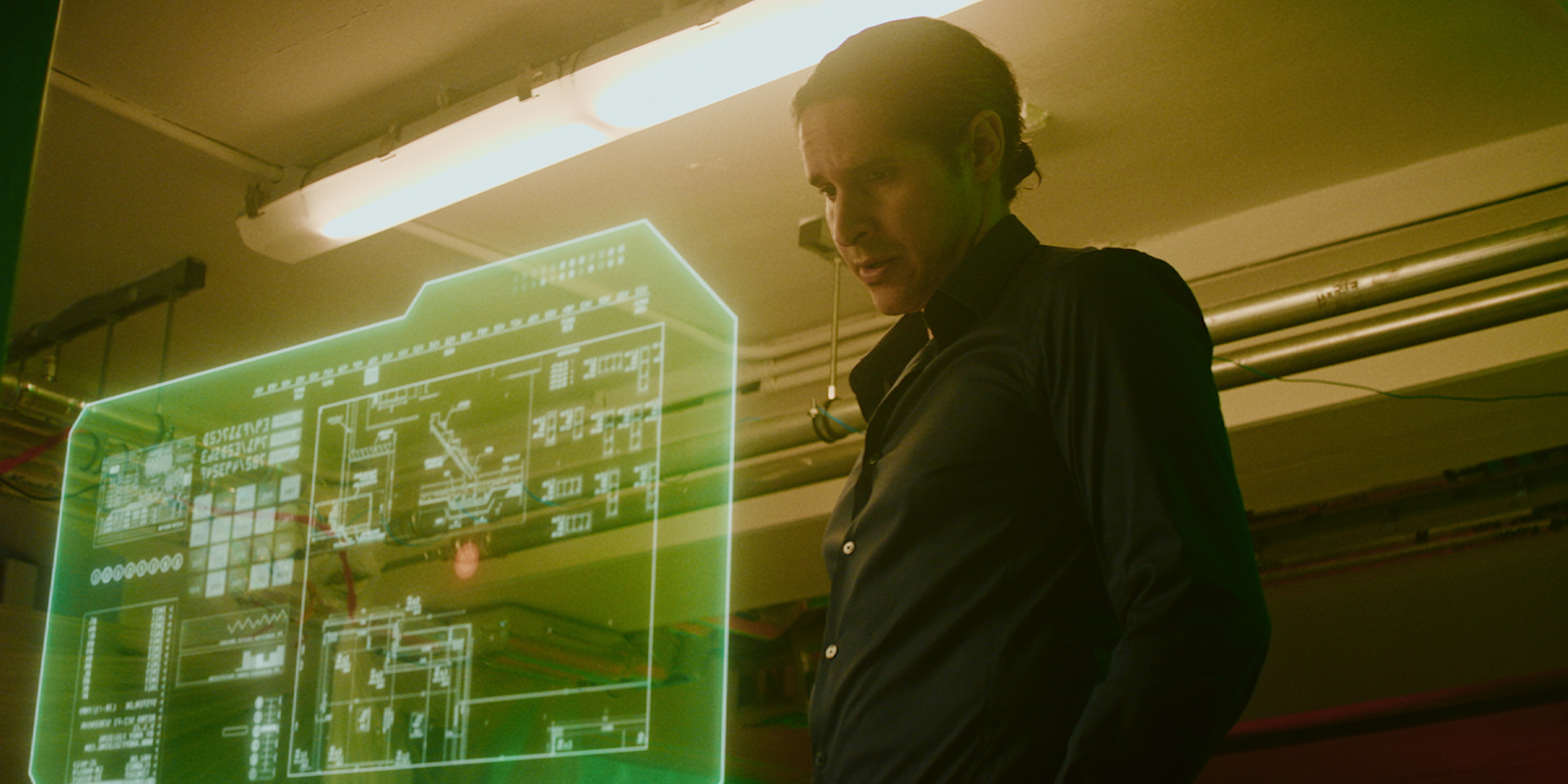
“I have to admit, I’m not super experienced at shooting VFX in camera,” Carman says, “so there were a lot of elements for which Derry would tell me what the VFX artist needed, or said what would work, and I just had to put a bit of blind faith into him and just be like, ‘Okay, if he says this is going to work, then it’s going to work.’
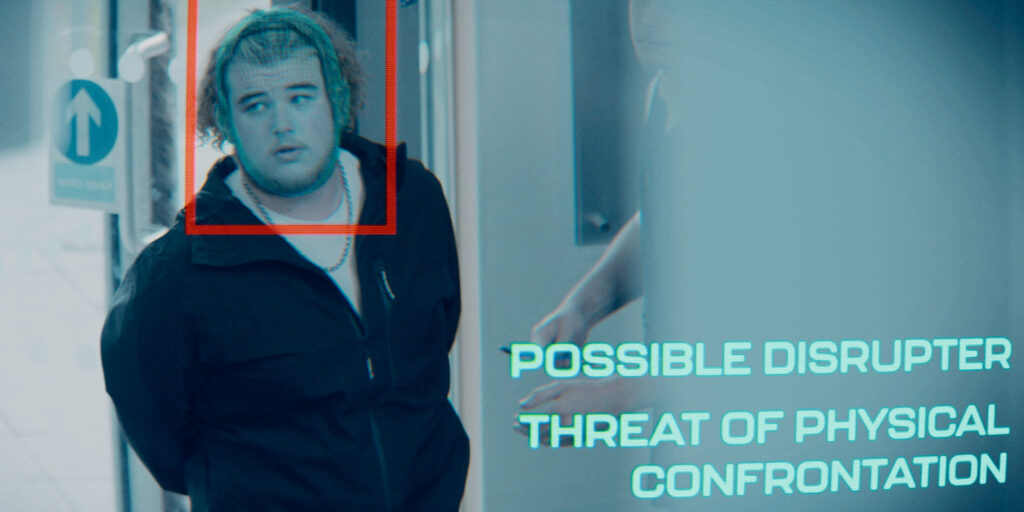
“There are definitely some parts where I wasn’t so sure, because for some scenes we just had an LED tube light or had to use an Apex Element as a reference, and when we had characters moving in front of it during the shot, I obviously started to think, ‘Is that going to be okay for our VFX guy? I don’t know.’ But Derry kept reassuring me that it’s not going to be a problem – he’s had to deal with worse, essentially. This guy, Steve Askey, was an absolute wizard with the VFX, and I think he’s done an absolutely fantastic job and really elevated the film.”
Admittedly, working with a tight budget meant placing restrictions on just how sci-fi the project could become, with Carman and Shillitto opting to steep the film in a “grounded reality” from the off. Their focus centered on creating a visual language that developed the film’s dystopian world in camera, without the need for too much work in post-production – even leaning into their constraints to hone their style.
“We initially wanted to use anamorphic lenses throughout, but we didn’t have the budget to use them for the whole production,” Carman says. “So, working with that restriction, we decided to have it so that anything that takes place inside the Unit is shown anamorphic, because the Unit has this feeling of being in a bit of a bubble.
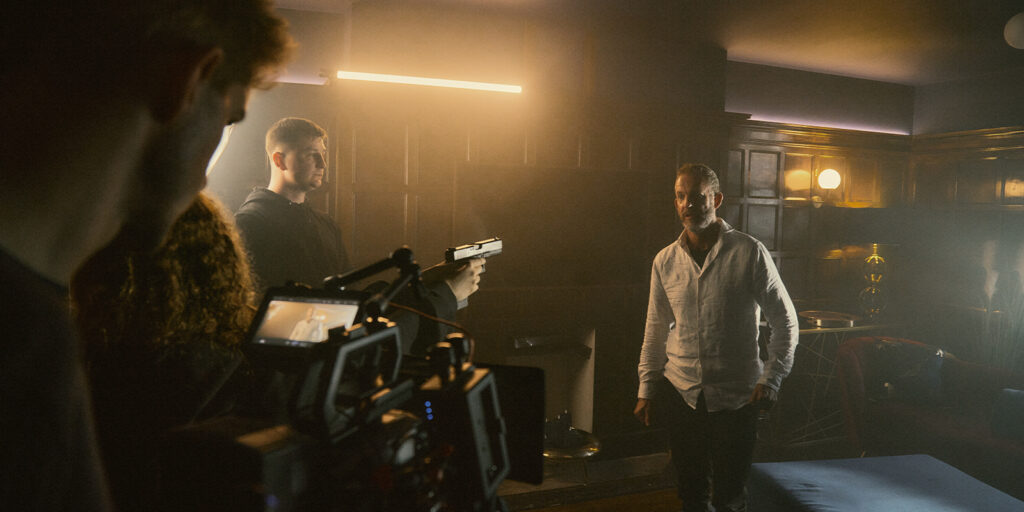
“It’s not meant to be a prison, but it kind of is for the characters. So, through having this little ecosystem, we developed a visual motif that would help sell that idea, and then everything that was shot externally, in the real world, was shot on spherical lenses, just to give more intentionality to the shots. And that meant that the limited availability of the anamorphic lenses was put to better use.”
Making science fiction a reality
Yet even within their restraints, the crew were able to embrace the genre, using VFX to bring nTrac to life and channelling seminal films like Blade Runner in pivotal scenes.
One such scene takes place in the ‘White Room’, where offenders are strapped to a chair and fed information through a VR headset. For Carman, there was only one reference point from which to build. “That was the white room scene from The Matrix. We obviously, ideally, wanted it to look a bit like that, but we didn’t quite have that kind of scale available to us.
“But we managed to go to one location, and it was interesting to shoot in because it was essentially just this room where they had this humongous LED wall, but it was only one wall on one side of the room. It was quite a tiny space to work in too, especially once you start to get the cast and crew involved and all of the lighting set-up.
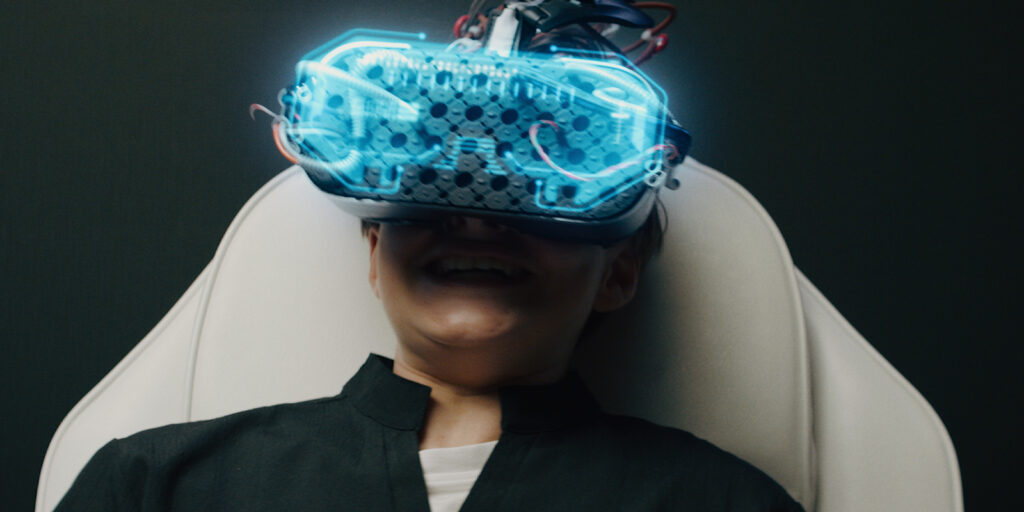
“It was interesting having to shoot that scene, because we had to always shoot in the direction of the LED screen to sell the illusion of this space being wall-to-ceiling white, which meant for any ‘reverse shots’ we were having to shoot in the exact same direction, but having to flip the blocking and position of the actors to sell that it was a different angle. That was quite a fun and interesting challenge to crack, to make sure we had the continuity right.
“You do question yourself a little bit, because your brain just thinks, ‘We’re shooting the exact same way.’ But you have to almost overthink it a little and take the time, so that you can confidently decide, ‘Yes, this is the right shoulder to shoot over. This is the right eyeline,’ and so on. We double-checked playback and even used overlays on monitors to make sure it would cut and not be jarring to the viewer.
“I think my main worry for those scenes was that it was going to look very flat from a lighting perspective, because the LED screen gives off a lot of light itself and the actors were having to stand so close to it sometimes, the white light bled onto them quite a lot. But again, working with low-budget restrictions, we leaned into elements that we could not control, and for this scene in particular, drew inspiration from films such as Minority Report, which has the classic ‘bleached bypass’ look with blooming highlights that we decided to lean into.
“We tried to sculpt the lighting a little bit more by bringing in a six-by-six frame above the chair with white bounce fabric, and we placed black fabric on half of it towards the camera just to create a little bit of contrast and fall-off, especially when they sit in the chair. And we bounced a couple of Aputure units into it, which created a nice, soft light, but it felt in keeping with the harshness of the LED screen as well. I think we managed to pull it off quite well.”
Action!
On the theme of The Matrix, there are even extended action sequences dotted throughout the film, including one street chase that culminates in an immersive car crash. For Carman, that scene presented a lot of challenges – but challenges that were exciting to overcome.
“The most nerve-wracking part of the main action sequence was the car hit, because we were only doing that once. We did not have the budget to get two cars or three cars to do that again, so we had to have multiple camera operators. I actually think at the time, on that specific day, we had to implement a B unit, so I sent off a couple of my team to shoot the sequence with the bicycle – where Shawn comes out of the alleyway and he hits the cyclist, that was shot by a B unit. Again, that was a bit of a new experience for me, having to direct a secondary unit. That’s not something I had to do before, on my first feature film.
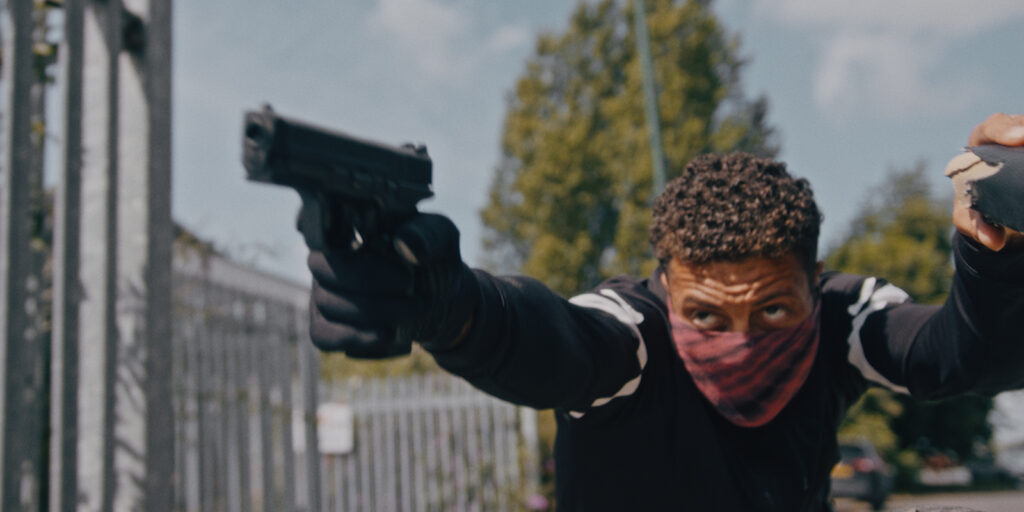
“But the team I worked with on this, they’re all experienced gaffers, camera operators, cinematographers in their own right as well. So I had faith that they would find the right angles to make it work.
“Then we had to all come together to shoot the car hit sequence, which was very, very fun, a little nerve-wracking – the camera I was on was the one where it captures the hit from the side. So I had to make sure that I got out of the way soon enough, so I didn’t get hit as well. Obviously there was loads of health and safety there, there was one of the stunt guys behind me, ready to pull me out if I lingered for too long. And I had three or four other camera operators dotted around the street on longer lenses, so that we could capture as many angles as possible, because we only had one shot at this.”
Learning on the job
The Correction Unit culminates in arguably its most sci-fi scene yet, with a relatively VFX-heavy climax that puts several characters at risk. Unlike the car crash scene, Carman had to think more about how to execute this sequence in post-production, rather than in camera.
“We felt like it was right for the film, as it progresses, to dive deeper into the sci-fi element of it, which I think makes it really, really fun as a journey – especially as an audience member, to watch it develop and then realise, ‘Oh yeah, this is modern day, but in a bit of dystopian reality too.’ It has a bit of a Black Mirror vibe to it – I think if people like that kind of show, they’ll enjoy this film.”
Going through the science fiction process, Carman learnt a lot of important lessons in only his second feature film – but his main takeaway is applicable to shooting every genre.
“Communication is obviously the most important thing,” Carman muses. “Ideally, in every production, you have a recce for each location, you have rehearsals for each scene, you’re able to give plans to your lighting and camera team so that when the shoot days come, they can just crack on with setting up.
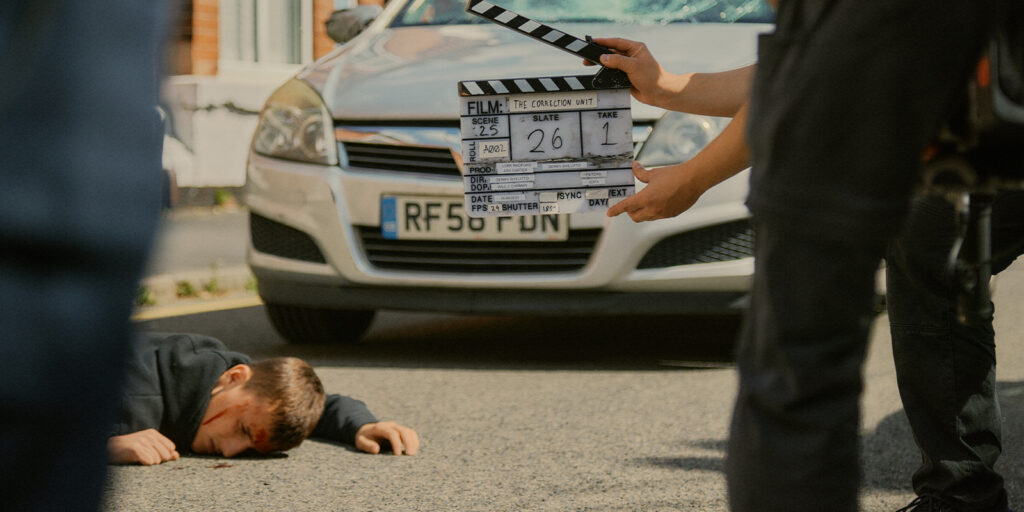
“However, like I’m sure anyone who has worked on low-budget features will agree, you sometimes don’t get all of those privileges. There were a lot of days where me and my team were having to think on our feet and in some ways ‘make it up’ as we went along, just due to the nature of sometimes not having the ideal location for a particular scene, or not being able to see the location beforehand, or not know what the blocking is going to be.
“One scene in particular that stands out as an example of where we had to very much think on our feet is towards the end of the film, where the young people rally together and unite against their common cause. We were originally supposed to shoot this scene in a completely different location, but we unfortunately no longer had access to it. So, we had to shoehorn it into another day where we were in a theatre space shooting other scenes.
“Myself and Derry initially walked around the office spaces available backstage, but I quickly decided that it was going to take too much time and effort to make them work, because they were all plain white rooms, so we were going to have to take away a lot of light using black fabrics, as well as bring in our own lights to sculpt the scene.
“However, we had the side of the stage available to us and that was already completely blacked out, so we had all of the contrast that we needed, we just needed to add light, rather than take it away as well. So, with no plan prior to this, I had a quick discussion with my lighting team and we got to work rigging up a few different units and were able to create a scene that looked great and still felt in keeping with the visual style and tone of the rest of the film.
“With challenges like this in mind, that had to be overcome on a regular basis, I’m really proud of the quality and consistency that myself and my team were able to achieve with the cinematography of this film.
“The experience was affirming in ways, because it gave me faith in myself. When I did my first feature film, I only had one camera assistant with me for the whole production. So going from that to a seven or eight person camera and lighting team on this production, I was initially quite nervous. But this film gave me confirmation in my own skill set, in a way – it confirmed that if you show up with the right team, you can always make things work, and I think that is something special that Derry has been able to create; aside from the film itself, he has created a close community of filmmakers who I’m sure will continue to work together for many years to come.”
The Correction Unit is now streaming on all major platforms.